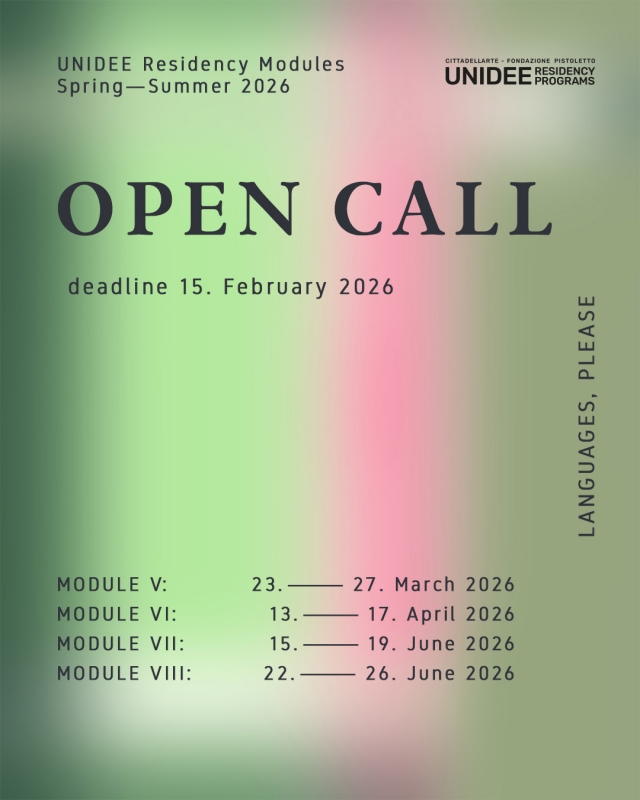
UNIDEE Residency Modules: LANGUAGES, PLEASE / Spring-Summer Seasons 2026 / open call & selected residents
MODULE V
Wen Lin Tan (SG/IT); Rac Montoro (IT); Anna Dusi (IT/MX); Susana Abdulmajid (DE); Mauro Diciocia (IT); Olga Kozmanidze (RU/IT); Andres Felipe Castano Rojas (CO/IT); Marianne Holm Hansen (DK/UK); Gloria Luca (RO/ES); Carola Demarchi (IT); Dominika Wasilewska (PL); Esth Fantuzzi (IT/BE); Esta Matkovic (HR/FR).
MODULE VI
Letizia Federico (IT); Zivile Fornari (ES/LT); Vir Andres Hera (MX/FR); Roberta Colombo (IT); Monica Sgrò (IT); Louis Nye (UK/ES); Laura Renna (IT); Caterina Erica Shanta (IT); Katya Moro Crisostomo (MX/UK); Victoria Vargas Downing (CL/UK); Lucia Veronesi (IT); Anna-Lena Panter (DE); Varvara Keidan Shavrova (RU/UK); Juan Pablo Garcia Sossa (CO/DE).
MODULE VII
Daniela Di Lullo (IT); Elia Kalogianni (NL/GR); Riccardo Rizzetto (IT/UK); Tommaso Giacomin (IT); Simona Rukuižaitė (LT); Maia Gattás Vargas (AR); Wera Grzes (PL/CH); Francesca Casale (IT); Ricardo Miranda (USA); Katya Mora Crisostomo (MX/UK); Varvara Keidan Shavrova (UK).
MODULE VIII
Swapan Mondal (IN); Mauro Diciocia (IT); Mercedes Balle Quiroga (ES); Zeynep Yılmaz (TR); Martha Schnee (USA); B Bordoni (IT); Majse Aymo-Boot (DNK); Maya Dikstein (BR); Marianna De Marzi (IT/FR); Sahar El Echi (TN); Nina Vurdelja (HR/FI); Māra Gaņģe (LV).
Module V: Piersandra Di Matteo
Module VI: Elvira Espejo Ayca
Module VII: Cromoactivismo and Marina De Caro
Module VIII: Francisca Benítez
UNIDEE Residency Programs and Fondazione Pistoletto Cittadellarte are pleased to announce an open call for applications for the modules of the spring and summer seasons of the programme Languages, Please, curated by UNIDEE Visiting Curators Nina Fiocco and Gaia Martino.
Languages, Please is an invitation to a collective series of rehearsals that explores languages as geopolitical spaces of dispute, narratives, and encounters. It is a call to engage with the porosity of our bodies in action and the narratives that can infuse and strengthen our practice of remaining polyphonic, amid the crumbling circumstances of the present.
To meet in a language embraces the paradox of feeling foreign but inside the language, consciously rejecting to be bound by borders and rules that the language itself may impose. The fragility and fleeting temporality of this process embody the very essence of the community as a political space: a plurality of possibilities forged by the acceptance of implicit differences and affective responses that sharing a language fosters in each of us. What is incomprehensible yet invisible—uncoded, unseen and unheard—is just as vital as what is comprehensible and visible. Moving beyond the individual existence as an isolated experience, our human and more-than-human bodies are constantly engaged in negotiating ecological relationships to defend our right to remain plural, precarious and complex. This is a call to delve into what it could mean to engage with sustainable acts of storytelling, reception, and the reclamation of spaces of coexistence—an ongoing, heterogeneous multiplicity of stories so far, in which collective imaginaries emerge from the reorganisation of the senses, rewriting and acting for justice, rather than from resonance or empathy. It is about breaking the habit of synthesis, shifting our attention from the stories that worlds tell us to the intricate micro-processes that compose these stories—memories, muscles, and multiple interwoven connections occurring at once.
The UNIDEE Modules programme is a short-term residency format for selected residents.
Participants will have the opportunity to cohabit at Cittadellarte and engage in an immersive, week-long residency, delving into their ongoing practice alongside peers, invited mentors, and guests. Discursive and material frameworks will intertwine, fostering a dynamic space where collective practice unfolds. Each module is interwoven within the 2025-2026 Modules program, threading together the fabric of Languages, Please.
To learn more about the project's context and objectives, please refer to the complete curatorial framework here.
Module V – Beyond Acoustic Supremacy—Gestural Voice and Transcorporeal Listening will take place from 23 to 27 March 2026, and it is led by mentor Piersandra Di Matteo.
The workshop engages listening as an embodied, relational, and political practice that exceeds cochlear and hearing-centered models of perception, operating as a vibratory, tactile, and affective force across bodies, gestures, spaces, and material environments. Beginning with liminal vocality, the process moves toward gestural voice—an embodied discursivity in which communication emerges through movement, rhythm, spatial articulation, and collective attunement. Voice appears here as a corporeal event rather than a sonic or linguistic object, disrupting the primacy of speech and the supremacy of auditory norms.
Drawing on Deaf epistemologies, regimes of aurality shaped by oralism, audism, and hearing-based hierarchies are critically interrogated. Through collective exercises, embodied experimentation, drawing, and movement-based dynamics, listening is reconfigured as a transcorporeal interface connecting inner perception and others, the human and the more-than-human world. Sound emerges as an agentive force, acting through vibrations, visual cues, bodily material and immaterial structures, and shared temporalities.
Piersandra Di Matteo combines short theoretical inputs with collective experiments—vocal and gestural practices, collective readings, spatial explorations, and the invention of a shared score—where practice becomes a site of complicity that challenges acoustic supremacy.
Module VI – Interlaced warps from the Andes will take place from 13 to 17 April 2026, and it is led by mentor Elvira Espejo Ayca.
This workshop is grounded in the text “Uywai - Uywaña. La crianza mutua de las artes” by Elvira Espejo Ayca, which, from Andean epistemologies, understands artistic practice as a collective, communal, and relational process. Elvira Espejo Ayca was born in the Marka Qaqachaka community of the Ayllu Qallapa (Avaroa, Oruro, Bolivia). A weaver since childhood, she learned textile knowledge from the master weavers of her family and community, encompassing archaeological, historical, and contemporary Andean techniques. Her work emphasizes the sharing of this knowledge through practical and theoretical teaching rooted in lived experience.The workshop is structured around textile practices and verbal practices as complementary and interdependent forms of language. Weaving is approached as a communal activity through which memory, knowledge, and social relations are sustained. Verbal practices—oral narration, collective reading, speaking, and listening—function alongside textile work as modes of transmission, reflection, and collective meaning-making. In dialogue with Biella’s historical relationship to wool and textile production, the workshop creates a shared space where Andean textile knowledge and local wool practices meet. Through hands-on work with wool and collective verbal exchange, participants engage weaving and language as practices of mutual nurturing, foregrounding collaboration, care, and continuity within the framework of Languages, Please.
IMPORTANT: This module will be conducted in both English and Spanish. A mixed-language approach will be adopted throughout the module. Participants are therefore expected to demonstrate openness to and engagement with a multilingual learning environment.
Module VII – Spell of Color will take place from 15 to 19 June 2026, and it is led by mentor Cromoactivismo and Marina De Caro.
Can color join the poetics of the word and political action?
How can political proposals enter into dialogue with the experiences and sensitivities that color provokes in our bodies?
Color, as a metaphor for a perceptible and plural form of knowledge—of sensitive and restless gestures—has the capacity to deconstruct social and hegemonic norms. Colors, as sensory expressions, question us and cease to be innocent when they touch the surface of all bodies and carry us to the deepest layers of the collective soul. It is in the body where color vibrates, when we share each affective tone of the world within a context that calls for sensitivities, ideas, and projects that involve us all. Color and its interpretation are linked to a historical context and situated within a personal and shared experience.
For Cromoactivismo, color is a tool that challenges the sensitive capacity of our bodies and becomes collective by identifying and sharing forms of knowledge that put dominant narratives under tension. Our singular and social body explores the emotional, the pulsional, the cathartic, the sensitive, the subtle, the sonic, the olfactory, and movement, in order to project itself into multiple ideas and projects—momentarily suspending the hegemony of the visual and rational analysis in the construction of our symbolic and material system.
Awareness of our movements and perceptions when passing through a singular, common, social, and political experience will be exercised so that we can revisit our ways of thinking, distance ourselves from hegemonic sensitivities and agendas, reformulate our desires, and project other events within a micropolitical space.
The workshop will allow us to revisit dominant concepts and ideas in order to question them. Initially, we will work with blindfolded bodily experience exercises, focusing on the singular. From these experiences and the new questions that arise from them, participants will share collectively, building a common working protocol. Cromoactivismo proposes to reclaim color as a metaphor and symbolic field for these shared and singular experiences.
The final proposal will be to name colors through a poetic premise and to create a new color chart that gives rise to other possible future narratives.
Module VIII – In crescendo: tool for assembly will take place from 22 to 26 June 2026, and it is led by mentor Francisca Benítez.
During this workshop we will embark on a collective exploration of the place we are in together: Cittadellarte, the lively legacy of Arte Povera, the Cervo River, the city of Biella and its community gardens. We’ll experiment on new ways of meeting between humans, non-humans and places. We will share visions and ideas, join efforts and skills. How can we work together on artistic research prescinding of current high tech technologies being fully in our bodies and in the physical space that surrounds us? Can the technologies of coded languages be questioned and expanded through collective practice in place? The residency is organized on a crescendo, from no voice to full volume, and from the intentions of one artist to the weaving of an artist collective. Improvisation, somatic listening, and body engagement could be used as strategies of participation. The methodologies the mentor brings to us come from sign language immersion programs, activist choirs, popular assemblies, and irrigation communities. Over the course of the residency, we’ll go from being silent strangers, into forming an assembly. Our interactions, collective decisions and making, will coalesce into something we’ll be able to share beyond us.
We aim to invite a group of up to 12 residents to take part in each module. The programme is open to international participants of all backgrounds, whose engagement sits anywhere across the broad spectrum of cultural practice and research, with no restriction regarding disciplines, media or methodologies of work. Applications from artists, musicians, performers, curators, storytellers, writers, theorists, designers, activists, all are welcome and encouraged. We welcome applications from both individuals and collectives. If applying as a collective, please specify the number of participants and the nature of your collaborative practice.
The selection of participants will be guided by the resonance between the poetics, concerns, and inquiries present in the applicant’s work and those articulated by the curatorial framework of the UNIDEE Residency Modules 2025-26, and the core themes of each module. Additionally, consideration will be given to the applicant’s interest to contribute to a program-based residency rooted in processes of active exchange and participation.
The Residency Modules will take place at Fondazione Pistoletto Cittadellarte, in Biella, Italy.
The UNIDEE and Cittadellarte spaces will host a large part of the programme, while further opportunities for exploring the urban and rural landscape of Biella and its immediate surroundings will be offered.
Participants will be accommodated within the premises of Cittadellarte, in single rooms equipped with bedding and towels, and with the use of shared bathrooms. In case of participation in the workshop as a collective, they will be accommodated in a shared room. The residential spaces offer basic cooking facilities and communal resting areas. Arrival is expected in the afternoon on the day before the module begins, with departure scheduled for the afternoon of the day following the module’s conclusion. Should participants have specific flight requirements, we can assess the possibility of accommodating a longer stay. We are happy to welcome participants with children and/or small pets, ensuring a comfortable and inclusive environment for all.
We are committed to meeting to the best of our ability any accessibility requirements an attendee may have; this will be discussed individually with prospective residents.
N.B: English will be the common ground for interaction within the residency module, yet the work will not be confined to it. Languages will be approached as open territories, and participants will be invited also to engage with expanded, non-codified forms of communication, hybrid languages, and multiple configurations of interaction shaped by backgrounds, interests, and practices of all individuals within the group.
Further information regarding practicalities and FAQ available here.
To ensure sustainability to the UNIDEE Residency Module Programs, the participation fee follows a participatory method: each selected resident contributes with a fee based on their financial context, monthly income, and personal circumstances at the moment of the module. The suggested fee is 280 euros per module, covering accommodation at Cittadellarte and administrative expenses. After the selection process, participants will be invited to share their proposed contribution.
A limited number of partial bursaries to cover travels are made available to those who would not otherwise be able to participate. Please make sure to indicate in your application if you wish to be considered for this opportunity.
Residents will be required to arrange and cover expenses for their travel to/from Biella and for the food/living costs whilst in Cittadellarte.
The team at UNIDEE remains at your disposal to support you in the visa application process and to offer guidance and recommendations with travel arrangements. Additionally, the team will provide you with any documents you may need should you decide to pursue other funding opportunities through your local art councils or via international platforms / funding bodies.
We accept applications through https://form.jotform.com/260184236179359 which includes detailed instructions for the application process. Applicants will receive a confirmation email once their submission has been successfully received.
Please note: Applicants must indicate their choice of one of the four modules and tailor their response accordingly. If they wish to apply for more than one module, separate applications, each appropriately written, are required.
Deadline for submissions is 15 February 2026, 23:59 (CEST).
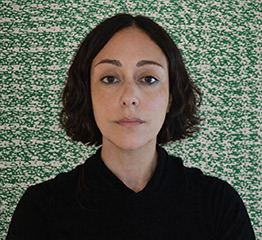
Piersandra Di Matteo • Scholar, dramaturg, and curator in the field of performing arts. She is currently a Visiting Associate Research Scholar at the Italian Academy of Columbia University and a member of the SSH | Sound Studies Hub at IUAV University of Venice, where she teaches Curating Performing Arts. She has lectured and led seminars at international research institutions, including the School of Creative Media (Hong Kong), LASALLE College of the Arts (Singapore), Shanghai Theatre Academy (Shanghai), SNDO (Amsterdam), the CUNY Graduate Center (New York), DAS Theatre (Amsterdam), the University of Pennsylvania (Philadelphia), La MITsp (São Paulo), and UQAM (Montréal). For over two decades, she has been the closest theoretical collaborator of Romeo Castellucci. She held the position of Artistic Director of Short Theatre Festival (Rome, 2021–2024), Fermento (2021–2022), and Atlas of Transitions Biennale (Bologna, 2017–2020), and she was curator of the Résidence Pluridisciplinaire at the Festival d’Aix-en-Provence (2024).
 ftp://fondazionepistoletto@ftp.cittadellarte.it/unidee.cittadellarte.it/userfiles/images/
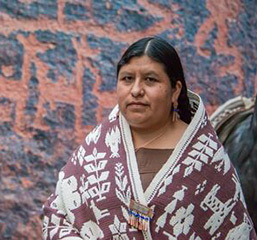
Elvira Espejo Ayca is a visual artist, weaver, and oral tradition narrator from the ayllu Qaqachaka (Oruro, Bolivia). Her practice is grounded in Andean knowledge and developed through an intercultural dialogue with contemporary artistic languages. She works in Aymara, Quechua, Spanish, French, and English.
She has received major international recognitions, including the Ibero-American Prize for Indigenous Art (2025), the Goethe Medal of the Federal Republic of Germany (2020), and the French Order of Arts and Letters (2024). Alongside her artistic, literary, and musical production, she has co-authored key reference works on Andean textiles and Indigenous knowledge systems.
Since 2013, she has directed the National Museum of Ethnography and Folklore (MUSEF), leading a critical, decolonizing, and community-centered renewal of its museological approach, gaining national and international recognition.
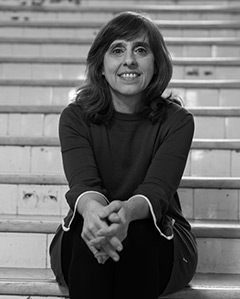
Cromoactivismo is a collective of poetic and transversal activism that intervenes in public space, political demonstrations, and cultural and educational spaces and institutions. We name colors through a poetics that accounts for situated experience, historical memory, and the political conjuncture, creating textual-visual devices. The collective production of posters, hand-painted cardboard placards, and other devices makes historical demands, social actions, and community calls visible, transforming the meeting space into a laboratory focused on the political dimension of color and the singular and collective experiences of the participants.
Since 2016, the collective has worked together with other collectives, groups, and schools in direct-action “cromoactivations” that promote gatherings of poetry, painting, and poster-making to intervene in different contexts. Until 2024, Cromoactivismo was made up of Marina De Caro, Mariela Scafati, Vic Musotto, Daiana Rose, and Guille Mongan. Currently, the collective includes Marina De Caro, Vic Musotto, and Guille Mongan, as well as all the institutions and collectives that have autonomously joined the initiative.
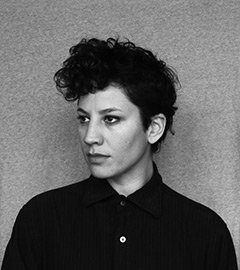 Francisca Benitez is a multidisciplinary artist born in Chile in 1974, living and working in New York since 1998. Her art practice explores relations between space, politics, and language, being closely linked to the places where she lives and the communities she interacts with. Her recent work Riego focuses on embodied research into vernacular irrigation practices in the rural region of Pichingal, Chile, where she grew up. Another key line of her research investigates sign language poetry and Deaf culture.
Her work has been exhibited internationally in galleries, museums, and biennials. Recent solo exhibitions include Trabajo de campo at Museo de Arte Contemporáneo, Santiago (2024–25), Direct Action at Storefront for Art and Architecture, New York (2023), and Riego at Die Ecke Arte Contemporáneo, Santiago. She holds a degree in Architecture from Universidad de Chile and an MFA from Hunter College, CUNY. She collaborates with artists and activist groups and is a co-founder of La Vieja Escuela, artes & cultivos, a collective project based in Pichingal, Chile.
You can know know more about her work here: franciscabenitez.org/cv/