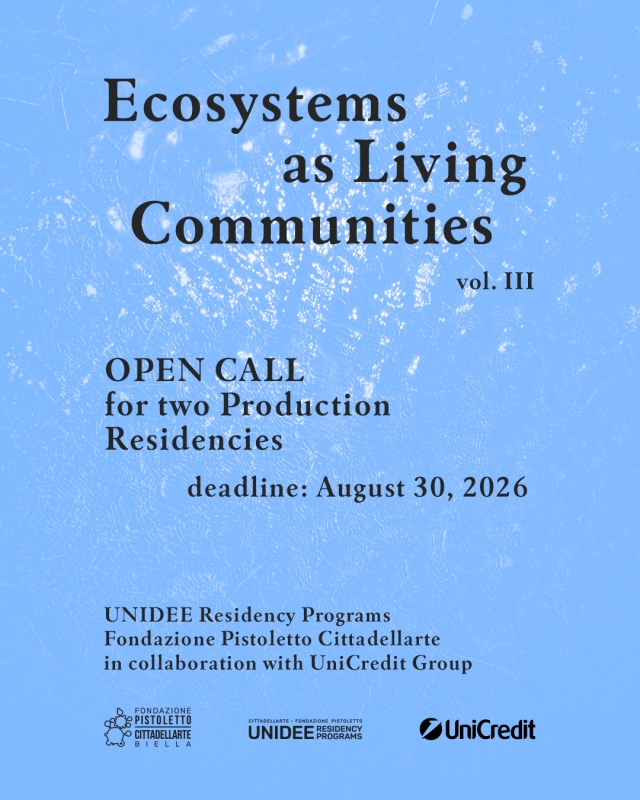
OPEN CALL “ECOSYSTEMS AS LIVING COMMUNITIES” vol. III UniCredit Group UNIDEE Connective Residencies 2026-27

UniCredit Group UNIDEE Connective Residencies 2026-27
with UNIDEE Residency Programs in collaboration with UniCredit Group
Fondazione Pistoletto Cittadellarte and UNIDEE Residency Programs, in collaboration with UniCredit Group, announce the third edition of the open call “Ecosystems as Living Communities”, supporting two production residencies for emerging international artists working with socially engaged artistic practices that address contemporary ecological issues.
The two selected artists, one Italian and one international artist residing in Europe, will take part in a residency dedicated to the creation and production of new artworks, which will become part of the UniCredit Art Collection.
In 2026, UniCredit Group renews its collaboration with Fondazione Pistoletto Cittadellarte and UNIDEE Residency Programs, launching the third edition of the project dedicated to supporting artistic research and production in response to contemporary ecological challenges. Building on the success of the previous editions, the initiative continues to promote interdisciplinary collaboration across scientific, technological, and humanistic fields, contributing actively to society’s sustainable transformation.
In continuity with the mission of Fondazione Pistoletto Cittadellarte, the vision and work of Michelangelo Pistoletto, and the United Nations’ Sustainable Development Goals (SDGs), the project reaffirms its commitment to environmental protection and sustainability. It encourages emerging artists to take on a pivotal role in the process of social and ecological transformation, engaging with the urgent challenges posed by climate change and the environmental and social crisis.
The third edition, continuing under the theme “Ecosystems as Living Communities”, invites artists to further explore global, contemporary, and future ecological challenges, fostering positive and regenerative visions of desirable futures. Artists are encouraged to propose projects that investigate ecosystems as interconnected communities of humans and non-humans, challenging anthropocentric perspectives and promoting an ecocentric mindset.
Envisioned as platforms for collaborative and cross-disciplinary inquiry, the residencies will foster dialogue between selected artists and experts from diverse fields, leading to the creation of new artworks that will become part of the UniCredit Art Collection.
The call welcomes artistic research exploring ecological transformation in its many forms. Proposed projects and artworks may investigate different dimensions of contemporary environmental transitions, including the role of water and other natural elements within ecological, social, and technological systems, alongside other themes related to sustainability, resilience, and ecosystem regeneration.
Artistic projects and artworks may engage with one or more of the following areas:
- Technological approaches to ecological transformation, investigating how digital tools, scientific research, and emerging technologies can reveal new perspectives on environmental systems and support more sustainable futures;
- Community engagement and environmental awareness, exploring educational, participatory, and community-based initiatives that foster collective reflection and action around contemporary ecological challenges;
- Circular and regenerative ecologies, exploring practices of reuse, repair, recycling, and responsible resource management across production systems—including fashion, food, manufacturing, and other industries—to foster more sustainable and resilient ways of producing and living;
- Water, natural elements, ecosystems, and sustainable futures, investigating the role of water and other natural elements, such as air, soil, minerals, and biodiversity, in shaping ecological systems, community resilience, and sustainable futures. Projects may address their environmental, social, cultural, and technological significance in the context of contemporary and future challenges.
The production residencies, known as UNIDEE Connective Residencies, aim to strengthen the dialogue between artistic research and other sectors of society. They foster a multidisciplinary and dynamic approach to building meaningful networks that connect artists with researchers, associations, industries, organisations, and members of civil society.
The residencies will take place between December 2026 and April 2027.
Two selected artists will engage in a shared research phase, including meetings with tutors, researchers, and experts, as well as field visits. The residency structure and schedule will be tailored to each project and defined collaboratively with the artists.
A collaborative attitude and flexibility in developing and implementing the projects—consistent with the evolving research process—are therefore essential.
The resulting works will be publicly presented at Cittadellarte in Biella and will become part of the UniCredit Art Collection. Moreover, the outcomes of the residencies will be disseminated online, contributing to broader public awareness and promoting responsible engagement with ecological and social transformation.
RESIDENCY TIME FRAME
- December 2026: Residency preparation phase at Cittadellarte (4 – 5 days, December 14–18, 2026).
- January – February 2027: Research and pre-production phase of the residency at Cittadellarte (including possible research visits) - schedule adapted to each project and agreed upon with the artists (3 weeks expected, between January 11–February 13, 2026).
- February – March 2027: Production phase at Cittadellarte - schedule adapted to each project and agreed upon with the artists (3 weeks expected, between February 15–March 27, 2026).
- April 2027: Exhibition preparation and public presentation of the artworks at Cittadellarte (2 weeks expected, dates TBC based on the official date of the event “Arte al Centro”).
ARTWORK GUIDELINES
The final artwork should be an original work developed within the framework of the residency and in dialogue with its main theme. Upon completion, the artwork will become part of the UniCredit Art Collection.
There are no restrictions on artistic language or medium. The artwork must be unique and produced as a single, non-editioned work.
The work should be suitable for long-term conservation; artists using ephemeral, living, or technically complex materials are required to provide detailed installation, maintenance, and conservation instructions.
For technically complex or large-scale installations, artists are also required to develop a simplified version of the work that can be installed in smaller exhibition spaces while preserving its conceptual integrity.
- A gross artist fee of €6,500, payable in accordance with applicable local and international regulations.
- A production budget of up to €2,500 to cover all costs directly related to the production of the final artwork, including installation supports, equipment rental, materials, and other necessary production expenses.
- Round-trip travel and research trips, with a combined budget of up to €1,000-1,500 per artist (depending on travel distance).
- Accommodation in a single room with shared facilities at Cittadellarte, along with a per diem of €25 per day (for up to 60 days) to cover meals and daily expenses.
- A research budget of up to €500 to cover fees for experts whose contribution supports the development of the artist's research during the residency.
Cittadellarte will separately cover technical support for the exhibition installation, the communication of the project and the production of a publication accompanying the residency and the final exhibition.
The final artwork produced during the residency will become part of the UniCredit Art Collection.
ELIGIBILITY
- The production residencies are open to emerging and mid-career artists, designers, architects, fashion designers, musicians, filmmakers, and other cultural practitioners whose creative practices engage with contemporary ecological issues.
- Applications are welcome from practitioners working across all disciplines, media, and methodologies, provided they can demonstrate previous experience in the production of artistic works. Interdisciplinary, cross-disciplinary, and experimental approaches are encouraged.
- Two artists will be selected: one Italian artist and one international artist residing in Europe (EU Member States; EFTA/EEA countries – Iceland, Liechtenstein, Norway, and Switzerland; the United Kingdom; and EU candidate countries).
- Fluency in English is preferred, as it will be the main working language of the residency. However, it is not a mandatory requirement, and applications from candidates with a sufficient level of English to participate in the programme are also welcome. Knowledge of the Italian language is not required, but it is appreciated.
- Candidates must be available to participate within the timeframes specified in this open call.
APPLICATION PROCESS
To apply for selection, please complete the online form: https://form.jotform.com/261934178865370 and submit the following documents, all in English:
1. Project Proposal (one PDF, up to 5 MB)
The PDF should include:
- Your project proposal, outlining how it relates to the main theme, which of the three research areas it addresses, and how it contributes to them (max. 2000 characters)
- Which forms of interdisciplinarity do you plan to activate and which kinds of expertise would you like to collaborate with? (max. 1000 characters)
- What medium will you use, and what form will your final artwork take? Please refer to the artwork guidelines (max. 1000 characters)
- Please also include a preliminary timeline (based on the residency timeframe) and an indicative budget for the proposed project. Both will be further refined together during the residency.
2. Portfolio and CV (one PDF, up to 5 MB)
The PDF should include:
- A selected portfolio with max. 5 projects/artworks most fitting to the topic of this call;
- A brief biography and CV.
The deadline for submissions is Sunday, September 6, 2026 at 11:59 PM.
If necessary, shortlisted candidates will be invited to attend an online interview between late September and mid-October 2026.
The successful candidates will be selected by mid-October 2026.
JURY
Applications will be evaluated by a jury composed of the Advisory Board of UNIDEE Residency Programs (Andy Abbott, Beatrice Catanzaro, Juan Sandoval, Alessandra Saviotti and Angela Serino) and in dialogue with Paolo Naldini, Director of Cittadellarte.
EVALUATION CRITERIA
The jury will evaluate the applications based on the following criteria:
- Relevance to the thematic framework. The proposal should clearly engage with one or more of the three research areas: technological approaches to water systems, community engagement and water awareness, or circular and regenerative productive ecologies.
- Artistic quality and originality. Evaluation will consider the conceptual strength, originality, aesthetic quality, and coherence of the proposal, as well as the clarity and distinctiveness of the artistic language as presented in the portfolio and previous projects.
- Research and methodological approach. Proposals should demonstrate a strong research foundation and a clear methodological approach, integrating artistic practice with scientific, technological, social, or ecological perspectives where relevant.
- Interdisciplinarity and collaboration potential. Particular attention will be given to the capacity of the project to foster interdisciplinary approaches and cross-sector collaborations between artistic, scientific, and community-based practices.
- Feasibility and clarity of the final artwork. The project should be feasible within the residency framework, with a clear articulation of process, timeline, and expected final output, including awareness of presentation and documentation requirements..
QUESTIONS?
For any further information, do not hesitate to write to unidee@cittadellarte.it